The Two-Thirds Door
The most instructive argument in the history of probability was not conducted between mathematicians. It was conducted between one magazine columnist and ten thousand of her readers, and the readers with doctorates behaved worst of all. It is a story about a game show, but really it is a story about what it costs to change your mind in public, and who is willing to pay.
The question arrived at Parade magazine in the late summer of 1990, from a reader in Columbia, Maryland named Craig Whitaker, and it sounded like nothing. You are on a game show. Three doors. Behind one, a car; behind the others, goats. You pick door number one. The host, who knows where the car is, opens door number three, revealing a goat, and asks whether you would like to switch to door number two. Is it to your advantage to switch? The woman answering was Marilyn vos Savant, whose column ran on the strength of a listing in the Guinness Book for the world’s highest recorded IQ, a credential that made her, depending on the reader, an oracle or a target. Her answer filled three sentences. Yes, switch. Your first pick wins one time in three; switching wins two times in three. She might as well have set fire to a post office.
The letters began as a trickle and became a landslide: roughly ten thousand in the end, and the number everyone remembers, close to a thousand signed by PhDs, many on university letterhead, many not merely disagreeing but performing disagreement with a relish that reads today like evidence in a trial the writers did not know they were attending. “You blundered, and you blundered big time,” wrote a mathematician from George Mason. “There is enough mathematical illiteracy in this country, and we don’t need the world’s highest IQ propagating more. Shame!” wrote another, from Georgetown. One correspondent suggested women simply look at probability problems differently. The tone is the tell. Nobody writes “Shame!” about arithmetic; they write it about status, about the intolerable spectacle of a magazine celebrity with no faculty position being right where the credentialed were wrong, except of course she was, on all counts, completely right.
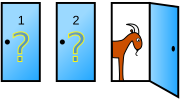
Since some readers of this essay are at this moment experiencing the same certainty that possessed a thousand doctorates, let me spend one paragraph on the trap itself, because the trap is beautiful. After the host opens a door, two doors remain, and the mind, seeing two options, announces fifty-fifty with the serenity of a law of nature. The error is treating the host as randomness, when he is in fact information wearing a tuxedo. Your first choice split the world into two regions: your door, holding one-third of the probability, and the other pair, holding two-thirds. The host then walks into the two-thirds region, and, knowing exactly where the car is, removes a door he is certain is empty. He has not diluted that region’s two-thirds; he has concentrated it, all of it, onto the door he conspicuously declined to open. Switching is not choosing one door; it is choosing both of the other doors, with the host having graciously swept the dud aside. If the fog persists, run the hundred-door version: pick one door of a hundred, watch the host open ninety-eight empties while stepping carefully around a single door, and ask yourself with a straight face whether it is fifty-fifty now. Nobody survives the hundred-door version. I have built the machine; it keeps receipts.
What elevates 1990 from brainteaser to case study is what happened, and failed to happen, next. Vos Savant did not retreat. Across three further columns she restated the logic, published the letters with names attached, and then did something quietly brilliant: she asked America’s math classrooms to run the experiment with paper cups and pennies, tens of thousands of schoolchildren dealing out the game and tallying results. The children found two-thirds, of course, and their letters, unlike the professors’, radiated delight. Meanwhile the single most credentialed holdout on earth, Paul Erdős, arguably the century’s most prolific mathematician, rejected the correct answer when a colleague showed it to him and stayed annoyed, according to his colleague Andrew Vázsányi’s account, until he was shown a computer simulation, an empirical rebuke, and even then wanted the reason, not just the tally. And Monty Hall himself, the actual host, invited a New York Times reporter to his dining room in 1991, dealt the game across the table with car keys and correctly diagnosed the whole affair, adding the practitioner’s footnote every theorist had skipped: on the real show, he was under no obligation to offer a switch at all, and could deploy the offer selectively, psychologically, as bait. The showman understood conditional probability better than the letter-writers with tenure, because his salary had depended on it.
The standard moral drawn here is that human beings are bad at probability, which is true and boring. The interesting moral is about the sociology of being wrong, because this episode is the cleanest natural experiment we have on the subject. Everyone starts in the same trap; what differs is the exit. The children updated instantly, because they had run the experiment and had no position to defend. Erdős updated grudgingly, an old man wrestling his own intuition to the mat because the evidence left no alternative, which is its own kind of nobility. And a distressing share of the letter-writers never updated at all, because they had done the one thing that makes updating nearly impossible: they had signed their certainty, on letterhead, with a flourish of contempt. The mind will abandon a belief with surprising grace; it will fight to the death for a belief it has publicly mocked someone else for doubting. Vos Savant’s critics were not defending a probability estimate. They were defending the version of themselves that had written “Shame!”, and no simulation can reach that door.
I think about this episode constantly in the context of markets and organizations, because both are machines for converting opinions into public commitments, and the doors problem shows precisely where the machine jams. An investor who has merely bought a position can sell it; an investor who has explained the position on a podcast now owns two assets, the stock and the story, and will typically part with the stock last. A leadership team that privately doubts the strategy can adjust it quietly; the moment the strategy has a slide, a slogan, and a town hall behind it, disconfirming evidence starts arriving at the building like Monty’s opened door, informative, unambiguous, and somehow never quite sufficient. The discipline this suggests is not humility in the abstract, which everyone endorses and no one schedules. It is structural: hold your certainties in forms that are cheap to exit. Say “my current model is” instead of “the answer is.” Attach probabilities instead of verdicts, because a man who said seventy percent can update to forty without dying, while a man who said “obviously” cannot update at all. Praise, loudly, in public, the colleague who changes their mind on evidence, because your team is watching what happens to that person the way readers watched vos Savant, and drawing conclusions about what candor costs in your building.
Vos Savant, for her part, paid the cost and collected the compounding. The woman mocked on letterhead in 1990 is remembered as the protagonist of the whole affair, and the mockery is remembered as a monument to a specific, eternal type: the expert whose expertise was real but whose relationship to being wrong was fatal. Three doors, one car, two goats, and beneath the arithmetic a question that has nothing to do with game shows and everything to do with how a life goes: when the host opens a door, when reality reveals a fact you did not expect and quietly offers you the switch, are you the schoolchild with the paper cups, or are you the letterhead? Most days I am not sure of my own answer, which I have come to believe is the only respectable state. The odds favor the switch. They nearly always do. The whole problem is that your first pick was the one you signed.
Notes & sources: the original column ran in Parade on September 9, 1990, from Craig Whitaker’s letter; the volume of mail (roughly ten thousand letters, near a thousand with doctorates) and the quoted responses are per vos Savant’s follow-up columns and her book The Power of Logical Thinking (1996); the classroom experiments were her own initiative across subsequent columns; the Erdős episode is recounted by Andrew Vázsányi and in Paul Hoffman’s The Man Who Loved Only Numbers (1998); Monty Hall’s dining-room demonstration and his caveat about the host’s freedom are from John Tierney, “Behind Monty Hall’s Doors,” The New York Times, July 21, 1991. Diagram: Wikimedia Commons, CC BY-SA.