The Referee Wears the Home Team’s Jersey
On regulatory capture: the oldest trick in the political economy playbook, and why the next fifty years of technology depend on whether we finally learn to see it.
In September of 2023, at a summit in Los Angeles, a six-foot-nine venture capitalist named Bill Gurley walked onto a stage and put a single number on the screen behind him: 2,851. It was, he explained, the number of miles between Silicon Valley and Washington, D.C., and it was also, in his telling, the most underrated reason the American technology industry exists at all. Gurley had spent twenty-five years at Benchmark backing companies like Uber, Grubhub, and Zillow (businesses that crashed headlong into taxi commissions, restaurant lobbies, and realtor associations), and he had come to a conclusion that most investors believe privately but rarely say into a microphone: the greatest wealth-creation engine in human history was built not because of proximity to power but because of distance from it. The software industry got fifty years of permissionless innovation precisely because nobody in Washington was paying attention, and now that everyone in Washington is paying attention, Gurley wanted to explain what happens next. His talk compresses the whole argument into a bumper sticker, regulation is the friend of the incumbent, and I’ve been turning it over ever since. I think he’s about eighty percent right, and the disagreement in the last twenty percent turns out to be the most important part.
The slow seduction
The phenomenon Gurley was describing has a name, and it is worth understanding precisely because it almost never looks like corruption. Regulatory capture is what happens when the agency created to police an industry ends up, gradually and often sincerely, serving it instead, and the mechanism is less like bribery than like gravity. Consider how it actually unfolds. A new agency needs expertise, and the only people who truly understand a complex industry are the people who work in it, so the agency hires them, consults them, and absorbs their assumptions along with their knowledge. The regulated firms show up to every hearing, comment on every proposed rule, and fund every study, because for them a single sentence of regulatory text might be worth billions; the public, whose stake is diffuse (a few dollars per person, an innovation nobody knows they’re missing), never shows up at all. Careers begin flowing through a revolving door until today’s regulator is yesterday’s industry executive and, more importantly, tomorrow’s. No individual step in this process requires a single dishonest actor. And yet, step by reasonable step, the agency comes to see the world through the incumbents’ eyes, until the rules it writes begin to look less like a fence protecting the public and more like a moat protecting the castle. The economist George Stigler formalized all of this in a 1971 paper called “The Theory of Economic Regulation,” work that helped win him the Nobel Prize, and his conclusion had the cold clarity of a man who had stopped being surprised: as a rule, regulation is acquired by the industry and is designed and operated primarily for its benefit. Not occasionally. Not in the worst cases. As a rule.
They were drawing this in 1889
What persuades me most about capture theory is not any single modern outrage but the sheer age of the pattern, because an error that repeats across centuries is not an accident; it is a structure. In January 1889, the satirical magazine Puck published a cartoon by Joseph Keppler that American history students still encounter today: a chamber of the United States Senate dwarfed by a row of bloated figures shaped like moneybags (the Steel Trust, the Copper Trust, the Sugar Trust, the Standard Oil Trust) looming over the proceedings beneath a sign reading “This is a Senate of the Monopolists, by the Monopolists, and for the Monopolists.” In the upper corner, Keppler added the detail that makes the image immortal: a “People’s Entrance,” bolted shut.
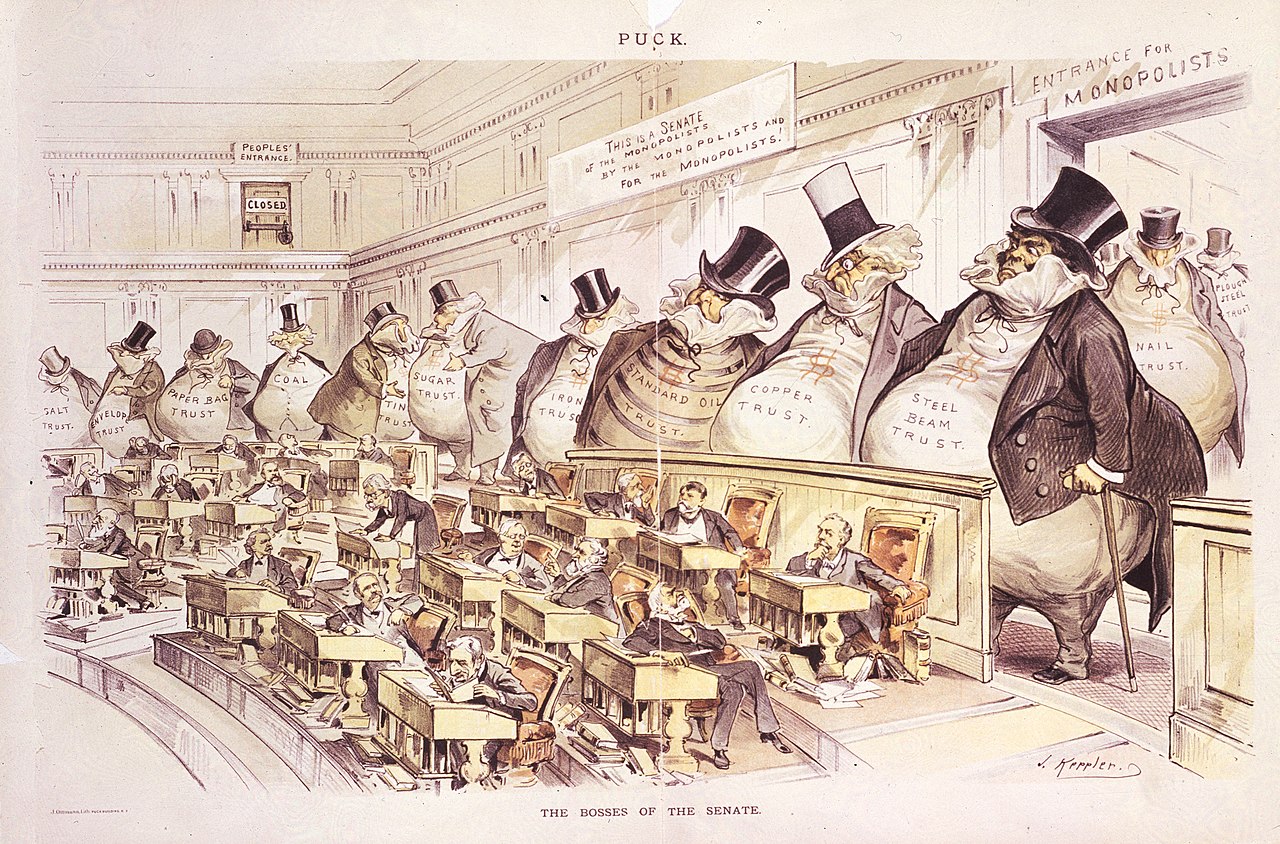
Two years before that cartoon ran, Congress had created America’s first federal regulatory agency, the Interstate Commerce Commission, expressly to rein in the railroad barons, and what happened next is the founding case study of capture. Within a few years, Richard Olney, a corporate lawyer who had spent his career representing railroads before becoming Attorney General of the United States, received a letter from a railroad president asking whether the Commission ought to be abolished. Olney’s reply is one of the most quietly damning documents in American economic history. Don’t abolish it, he advised; the Commission was in fact a useful shield, because its very existence satisfied the public clamor for oversight while its supervision was “almost entirely nominal,” and the older it got, the more it would take “the business and railroad view of things.” The wisest course, he wrote, was “not to destroy the Commission, but to utilize it.” The historian Gabriel Kolko would later argue that this was not a corruption of the ICC’s purpose but something closer to its function: the railroads’ true terror was not government but each other, and a federal rate-setter delivered the one thing competition never would: stability. The referee, in other words, was wearing the home team’s jersey almost from the opening whistle. And if you keep walking backward through history the silhouette never changes: the medieval guilds that persuaded city councils to outlaw practicing a trade without membership, quality control in theory and competitor control in practice; the British East India Company, which did not out-trade its rivals so much as out-lobby them, holding a crown-granted monopoly for two and a half centuries; and their direct descendant, modern occupational licensing, under which several American states have at various times required government permission to braid hair or arrange flowers, requirements championed, without exception, by incumbent hair-braiders and florists rather than by any recorded victim of an unlicensed bouquet.
The modern gallery
If the pattern is ancient, the receipts are current, and Gurley’s talk assembles them with a prosecutor’s patience. Begin with the law that was explicitly sold as the pro-competition landmark of its generation: the Telecommunications Act of 1996, five hundred pages of carefully negotiated text that promised to open the phone and cable markets to a thousand hungry challengers. When the bill passed, the four largest telecom providers controlled about 48 percent of the American market. Five years later they controlled 85 percent. Nobody needed to ban competition outright; the maze itself was the moat, because a five-hundred-page statute is a subsidy paid to whoever can afford the most lawyers, and the incumbents could afford them all.
The “pro-competition” law that concentrated the market
Combined U.S. market share of the top four telecom providers, before and after the Telecommunications Act of 1996
The same lobby soon demonstrated what happens to a challenger who slips past the maze. A startup called Tropos Networks had built mesh Wi-Fi routers that let a city blanket itself in cheap or free municipal broadband, and for a moment in the mid-2000s it looked like internet access might become something a town provided the way it provides streetlights. The telecom industry’s response was instructive precisely because it did not involve building a better product or cutting a price: its lobbyists went to the state legislatures and got municipal broadband banned or hobbled in roughly twenty states, and Tropos’s market evaporated by statute. Then consider the EpiPen, where the mechanism shows up on a pharmacy receipt. After Mylan acquired the rights to the auto-injector in 2007 (a device whose underlying technology and drug were both decades old), the list price of a two-pack climbed from roughly one hundred dollars to over six hundred, and it could climb because would-be competitors kept getting tangled in the FDA’s approval gauntlet while Mylan’s lobbying pushed EpiPens into schools by force of law. A market with a regulator standing at the door, it turns out, is a market where the incumbent sets the price of your child’s allergy medicine like a toll collector who owns the only bridge.
The EpiPen: same device, same decade, six times the price
U.S. list price of an EpiPen two-pack after Mylan acquired the rights, 2007-2016 (USD)
If you want the cleanest experiment the field has ever produced, the pandemic supplied it, because for one strange year the same commodity product was regulated two different ways on two sides of the Atlantic. Germany’s health authority evaluated some 120 manufacturers of rapid antigen tests, validated 96 of them, and let them fight for shelf space; by the winter of 2021 a German could buy tests for under a euro apiece at the grocery store. The FDA, over the same period, approved a small handful, and an American standing in a CVS paid twenty-four dollars for a box of two, during a public-health emergency, for a strip of paper in plastic housing. Nobody designed that outcome, exactly. But nobody who profited from it complained, either, and the manufacturers inside the FDA’s walls had every incentive to praise the rigor of the very gauntlet that kept their competitors outside.
Same test, two regulators
Approximate retail price per rapid antigen test, winter 2021-22 (USD equivalent)
The subtlest exhibit in the gallery is also the biggest, because it involves the software running underneath American medicine itself. When the HITECH Act passed in 2009, it set aside billions of dollars in incentive payments for doctors who adopted electronic health records, provided the software they bought was “certified,” with certification thresholds that happened to align neatly with what the largest incumbent vendor, Epic Systems, already sold. Epic’s founder, Judith Faulkner, sat on the federal health-IT policy committee advising the administration that wrote those rules. There was no scandal, no indictment, nothing so vulgar as a bribe; there was simply a market where the government paid customers to buy the incumbent’s category of product, certified to the incumbent’s specifications, and fifteen years later health-care software remains the most despised, least interoperable corner of American technology. Zoom all the way out and you can see the cumulative price of this pattern written across the entire economy. Sort twenty-five years of consumer price data by sector, as the economist Mark Perry famously did, and the chart splits like a genome under a gel: nearly everything that became radically cheaper (televisions, software, toys, phone service) lives in the fiercely competitive, lightly regulated part of the economy, while nearly everything that outran inflation itself (hospital services, college tuition, medical care) lives in the part where incumbents help write the rules.
Where prices exploded vs. where they collapsed
Change in U.S. consumer prices by category, 1997-2023
And lest this all sound like history, the pattern is running in real time on two of the biggest stages in the economy. In aviation, after two 737 MAX crashes killed 346 people and exposed the fact that the FAA had delegated much of Boeing’s safety certification to Boeing itself, and after a door plug blew out of the side of an Alaska Airlines jet at sixteen thousand feet in January 2024, the agency finally cracked down, only to begin, by 2025 and 2026, handing certification authority back, with the company and its regulator now alternating sign-off duties week by week like co-workers sharing a shift. And in artificial intelligence, the newest and richest arena of all, researchers are already documenting the early choreography of capture: the loudest voices calling for AI licensing regimes belong, curiously, to the handful of incumbent labs that would be first through any licensing gate, and whose future competitors would not. Gurley saw this one coming from the stage, which is why he champions open-source models so fiercely: open source is the one form of competition that cannot easily be regulated away, because there is no company to bar from the market, only an idea already loose in the world.
Where I part ways with the bumper sticker
I wanted to end this essay in full agreement with Gurley. Agreement would have made for cleaner writing, and the gallery above made it feel earned. But the Boeing file would not let me, and here is where I get off the train, at a precise stop: if “regulation is the friend of the incumbent” hardens into “therefore deregulate everything,” you have not escaped capture; you have simply been captured by a different interest group, one that happens to hold the microphone at investment conferences. The Boeing story, read honestly, cuts both ways. The 737 MAX was not brought down by an overbearing bureaucracy smothering innovation; it was brought down by self-certification, by a hollowed-out FAA that had outsourced its judgment to the very company it existed to police, and nobody surveying 346 graves concludes that the cure is fewer safety rules. The venture investor Steve Blank made a version of this argument in direct response to Gurley, and it deserves to be taken seriously: some markets are regulated because their failure modes are airplanes falling out of the sky, banks collapsing in a weekend, and medicines that kill the patients they were meant to save. Anyone tempted to believe that the absence of a referee produces a fair game should revisit 2008, when the effective regulators of mortgage securities were credit-rating agencies paid by the very banks whose products they rated (capture in its purest, fully privatized form, no government required), and the game that resulted vaporized nine million American jobs.
So the honest position, I’ve come to think, holds three ideas at once, and refuses to let any one of them crowd out the others. The first is that Stigler was simply right: capture is the default outcome, not the exception, and every regulatory proposal should therefore be read with a single clarifying question in mind: who showed up to write this, and what would it cost their competitors? When incumbents lobby for regulation of their own industry, as the telecoms did for broadband restrictions and Mylan did for EpiPen mandates and the AI labs now do for licensing, that is not civic virtue on display; that is moat construction, and it should be named as such in public. The second idea is that the cure is not zero regulation but capture-resistant regulation, which is a real discipline with real design principles: simple rules instead of five-hundred-page mazes, because complexity is a regressive tax that only incumbents can afford to pay; sunset clauses, so that every rule must periodically re-justify its existence in daylight rather than persisting by inertia; genuine cooling-off periods on the revolving door; regulation of outcomes (this device must not fail, this test must detect the virus) rather than processes that quietly enshrine the incumbent’s way of doing things; and the massive transparency Gurley himself prescribes, so that lobbying happens on the record instead of at dinner. The third idea is the yardstick that makes the first two usable: competition is the best regulator humanity has ever discovered, and every rule should be scored on whether it protects competition or protects competitors. Those two phrases sound nearly identical. They are opposites, and the entire argument lives in the gap between them.
What haunts me most about capture, in the end, is not the EpiPen markup or the twenty-four-dollar box of tests, infuriating as those are, but the ledger nobody can audit: the graveyard of things that never existed. The municipal broadband never built. The generic injector never approved. The startup never founded because the compliance budget alone exceeded the seed round, whose founders took jobs at the incumbent instead and whose product we will never know we missed. The nineteenth-century French economist Frédéric Bastiat called this the unseen, and it is precisely the unseen-ness that makes capture so politically durable: a visible victim makes the evening news, but an invisible casualty cannot even know it was robbed, let alone organize. Silicon Valley’s 2,851 miles of distance from Washington bought it fifty years of permissionless innovation, and that era is over; the distance is now zero, the AI labs have offices on K Street, and the hearing rooms are standing-room only. Whether the next fifty years look like the internet or like healthcare IT will turn on whether ordinary readers (voters, founders, people standing in pharmacy aisles) learn to tell the difference between a rule that protects people and a rule that protects incumbents while dressed as one. The tell, mercifully, is usually simple: watch who’s cheering.
Sources & further reading: Bill Gurley, “2,851 Miles” (All-In Summit); transcript and slides; George Stigler, “The Theory of Economic Regulation” (1971); Gabriel Kolko, Railroads and Regulation (1965); Wikipedia: Regulatory capture; Fortune on Gurley’s AI warning; Claims Journal on the FAA restoring Boeing’s certification authority; AI & Society study on capture in AI policy; Steve Blank’s rebuttal to Gurley. Chart data: BLS CPI (after Mark Perry’s “chart of the century”), Mylan list prices as reported in 2016 congressional testimony, and figures cited in Gurley’s talk. Cartoon: Joseph Keppler, 1889, public domain via Wikimedia Commons.