The Laugh in the Boardroom
In the spring of 2000, two men flew to Dallas to sell their company for fifty million dollars. The buyer nearly laughed them out of the room. Everyone present was smart, informed, and acting reasonably. That is what makes it the most instructive meeting in modern business.
Picture the room, because the room matters. It is early 2000 at the Renaissance Tower in Dallas, twenty-something floors of mirrored glass above a city that still rents its movies on Friday nights. In one chair sits John Antioco, chief executive of Blockbuster Video, a man who has spent his career running convenience stores and gas stations and knows more about impulse retail than nearly anyone alive. His company has roughly nine thousand stores, tens of millions of members, and a river of revenue so dependable it might as well be a utility. Across the table sit two visitors from California who have flown in on a red-eye they could barely afford: Reed Hastings and Marc Randolph, founders of a money-losing startup that mails DVDs to people in little red envelopes. They have come with a proposal. Netflix will sell itself to Blockbuster for fifty million dollars, and in exchange Hastings and Randolph will run Blockbuster’s online arm, the way a small tugboat might offer to steer an ocean liner around a reef only the tugboat can see.
Randolph wrote later that somewhere in the middle of the pitch he noticed Antioco’s expression, the corners of a mouth fighting gravity, and realized with a hot flush that the chief executive of Blockbuster was struggling not to laugh. The meeting ended politely, the way meetings do when one side believes it is talking to the future and the other side believes it is talking to a rounding error. The Netflix founders flew home in a rented Volvo’s worth of silence. There was no counteroffer. There was no follow-up call. Fifty million dollars, for the whole thing, and the answer was a smile you could hear.
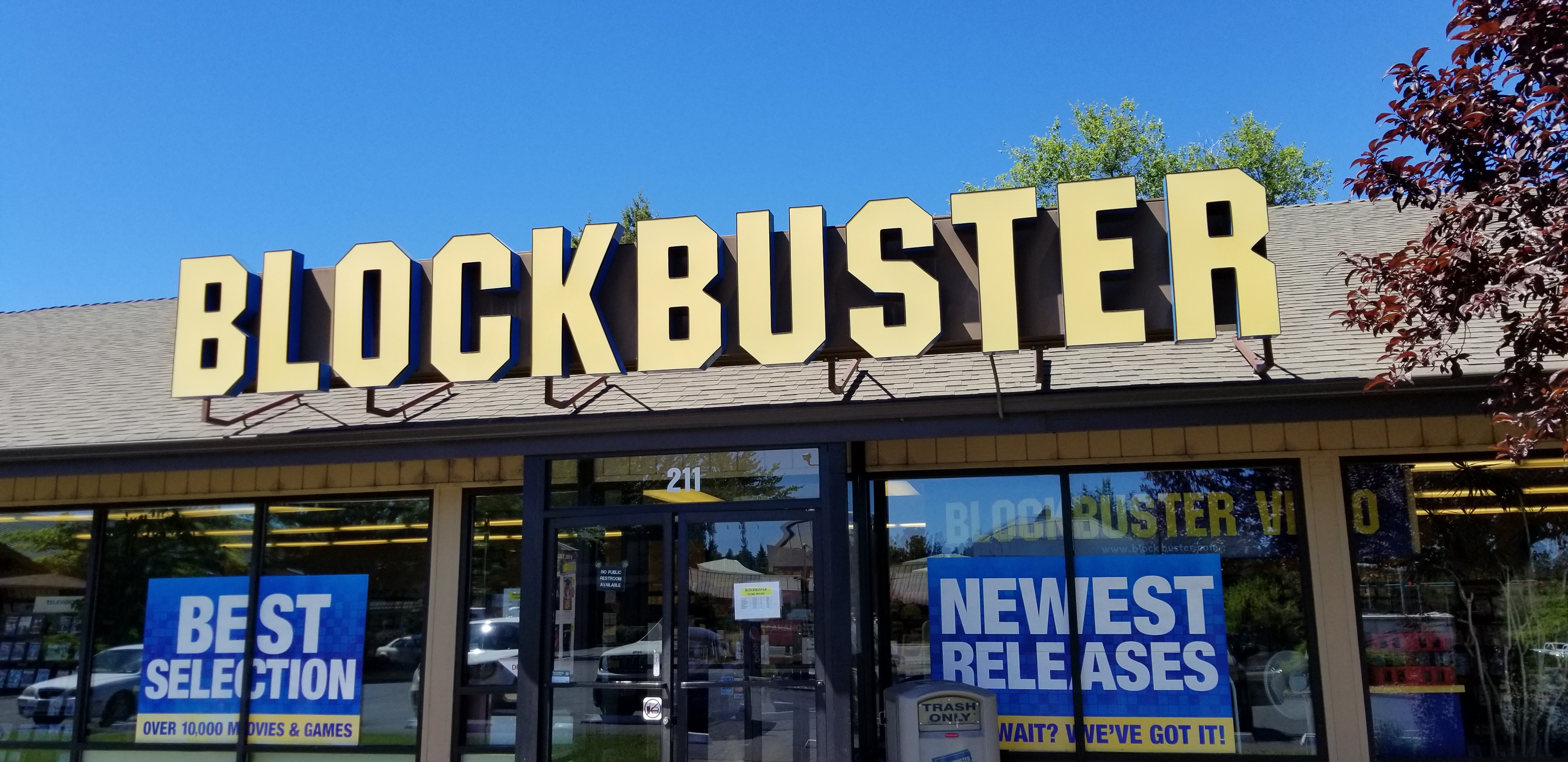
The easy version of this story, the one told in a thousand LinkedIn posts, is that Blockbuster was run by fools. The easy version is wrong, and the wrongness is the entire point. Antioco was not a fool; he was one of the best retail operators of his generation, and in the year 2000 he was right about almost everything. Netflix was losing money. DVD-by-mail was a niche serving early adopters with broadband patience and no late fees to resent. Blockbuster’s stores generated billions in revenue, and its most controversial line item, the late fee, brought in something in the neighborhood of eight hundred million dollars a year, nearly pure profit, the kind of money that does not just pay for headquarters but colonizes the imagination of everyone who works inside it. Any discounted cash flow model you built that morning in Dallas said Antioco made the right call. That is precisely what should frighten you. The models were correct and the decision was catastrophic, because models price businesses, and what walked into that conference room was not yet a business. It was a bet on how sixty million households would behave once the internet got fast, and there was no cell in the spreadsheet for that.
What the laugh protected was not analysis. It was identity. Blockbuster knew itself as a company of stores: leases, staff, end-caps, the smell of popcorn and plastic. Every institution develops an immune system, and the immune system’s job is to attack foreign ideas before they metastasize into new org charts. A fifty million dollar acquisition would have been trivial financially, but it would have been an admission, wired into the company’s own structure, that the stores were mortal. Rooms full of smart people almost never say yes to admissions like that, because the person who proposes the admission bears all the social cost immediately, and the benefit arrives years later, unattributed. Nobody was ever fired at Blockbuster in 2000 for declining to buy a money-losing DVD mailer. The incentives in that room were airtight. That is what airtight incentives produce: a smile, a handshake, and a company with nineteen years to live.
Here is the part of the story almost nobody tells, and it is the part I find genuinely painful. Blockbuster nearly won anyway. By 2004, with Netflix growing too fast to ignore, Antioco did what the caricature says he never did: he moved, and he moved hard. Blockbuster launched its own online service, and then did something braver than anything Netflix ever had to do. It killed the late fee, walking away from hundreds of millions of dollars of profit in a single announcement, and rolled out a program called Total Access that let customers rent online and return in stores, a weapon Netflix structurally could not copy because Netflix had no stores. It worked. By 2006 Blockbuster Online was adding subscribers faster than Netflix, and inside Netflix the executives were not smirking anymore; they later admitted Total Access was the one moment they believed they might lose. Netflix quietly approached Blockbuster about a deal to take the online business off their hands. The tugboat had grown a hull. The liner had finally turned.
Then the ending arrived, and it did not come from the market. It came from the boardroom, the same room, spiritually, where the laugh had happened. The online push was burning cash, as insurgencies do, and Carl Icahn, who had bought his way onto the board, was at war with Antioco over strategy and over pay. The fight ended the way corporate fights end, over a bonus, of all things, and Antioco walked. His successor, Jim Keyes, arrived from the convenience store world, looked at the numbers with perfectly conventional eyes, and did the perfectly conventional thing: he cut the online marketing, raised online prices, and refocused on the stores, which were, after all, where the money was. Every sentence of that logic is defensible. The sum of the sentences was surrender. Netflix executives have said, in so many words, that the day Blockbuster gutted Total Access was the day they stopped being afraid. Blockbuster filed for bankruptcy in September 2010. Today one store remains, in Bend, Oregon, selling nostalgia by the night. Netflix, the rounding error, became one of the most valuable entertainment companies in the history of the world.
The price of a smile
Approximate enterprise value, in billions of dollars (log-ish mental scale, not to scale)
I keep returning to this story not because Blockbuster lost, but because of when it lost. It did not lose in 2000, in the room with the laugh; it survived that mistake and clawed its way back level. It lost in 2007, when it was winning, because the organism finally rejected the transplant. That sequence tells you the laugh was never really about Netflix. The laugh was a symptom of a company that could not hold two identities at once, and when forced to choose between the identity that printed money today and the one that might exist tomorrow, it chose today, twice, a full seven years apart, with two different chief executives and completely different information. Structure beat judgment both times. If you want a definition of strategy that survives contact with real organizations, it might be this: strategy is whatever your incentives will still permit you to do once the future starts costing you money.
There is a test hiding in this story, and I try to run it on myself more often than is comfortable. When something small and absurd is pitched to you, a product that seems like a toy, a candidate who does not fit the template, an idea that would embarrass you to champion, notice what your face wants to do. The smile is information. It is usually not information about the idea; it is information about which of your own revenue streams, habits, or self-images the idea just threatened. Most of the time the toy really is a toy, and the smile costs nothing. But the expected value of the exception is so violently large that the discipline of pausing on your own smirk, of asking what would have to be true for this to be the meeting I tell my grandchildren about, is one of the cheapest disciplines in all of decision-making. Antioco was granted two chances at the same lesson, which is one more than most of us get. The room laughed once, the board flinched once, and between those two small, reasonable, defensible moments, an empire of nine thousand stores quietly agreed to die.
Notes & sources: the Dallas meeting and the suppressed laugh are recounted in Marc Randolph’s memoir That Will Never Work (2019) and in Reed Hastings and Erin Meyer’s No Rules Rules (2020); late-fee economics and the 2004–2007 online war are drawn from contemporaneous coverage in Variety, The New York Times, and Gina Keating’s Netflixed (2012), including Netflix executives’ later admissions about Total Access; Blockbuster filed for Chapter 11 on September 23, 2010; the final store operates in Bend, Oregon. Valuation figures are rounded for scale. Photo: Wikimedia Commons, CC BY-SA 4.0.