The Last Interface
Every era of computing has shortened the distance between what we want and what the machine does. We are now closing that distance entirely, and we should think hard about what stands in the remaining gap.
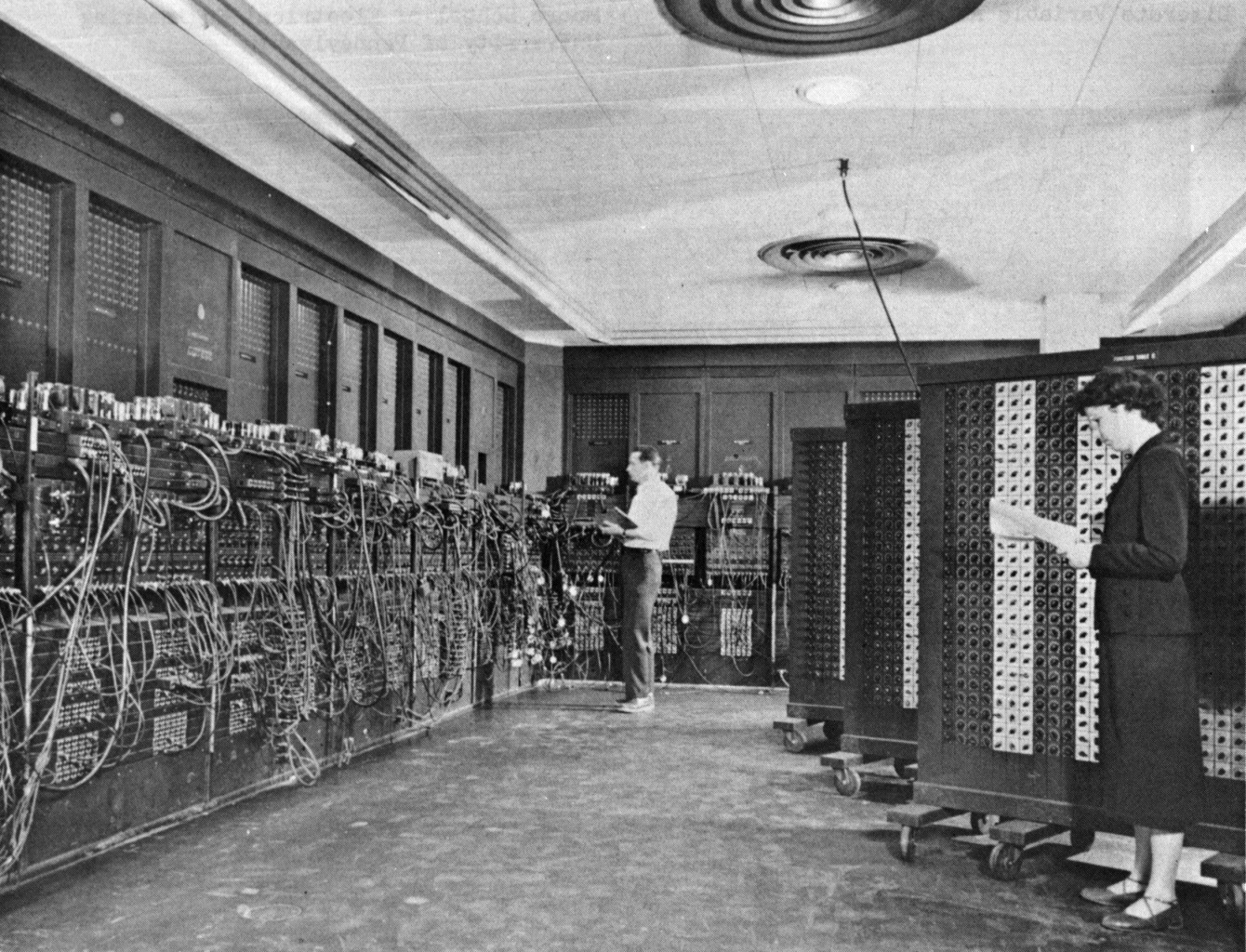
In the spring of 1946, if you wanted to give a computer an instruction, you walked inside it. ENIAC, the first general-purpose electronic computer, filled a room at the University of Pennsylvania: eighty feet of black steel panels, 17,468 vacuum tubes, a machine that consumed so much power that a probably apocryphal but persistent legend claimed the lights of Philadelphia dimmed when it switched on. Programming it was not typing; it was rewiring. A team of six mathematicians, most famously women like Betty Snyder and Jean Bartik whose names the newspapers of the day did not bother to record, would spend days setting switches and replugging cables by hand to prepare a single calculation, tracing the logic of a ballistics equation through a forest of wires. The distance between a human intention (tell me where the shell will land) and the machine’s execution of it was measured in days of physical labor. The entire history of computing since that room can be told as one long campaign to shorten that distance, and the campaign is now approaching something like an endpoint. That is what this essay is about: what happens when the distance between wanting and doing falls, for the first time, to zero.
Consider, by contrast, how I began today, and how most of us now begin every day. Before I was fully conscious I had silenced an alarm, checked the weather, scanned messages, glanced at a calendar and the markets, and asked an artificial intelligence to summarize what I had missed while sleeping. Each act feels small, almost beneath notice, but together they reveal something enormous about modern life: we no longer use technology when we need it; we wake up inside a technological environment that has already organized the day on our behalf. While writing this essay I audited my own phone and found myself embarrassingly typical of the era. Somewhere on the average phone sit roughly eighty applications, each one a company, a service, and a small claim on our attention. We will open perhaps nine or ten of them today and maybe thirty over the course of the month, but their silent presence on the home screen tells the story of the era we are now leaving: the app era, in which every human need was translated into an icon, and every icon dreamed of becoming a habit.
The app era, measured
Apps on the average smartphone vs. apps actually used (approximate industry figures)
At the RAISE Summit in Paris, a gathering of the people building the next generation of AI systems, a prediction was floated that sounds at first like the technology industry’s usual theater: the keyboard and mouse are dying. Every product in that world is revolutionary; every launch marks the dawn of a new civilization; the wise reader applies a discount. But underneath the theatrical language sits a serious historical argument, because every major wave of computing really has changed not just what machines do but how human beings approach them. The mainframe era required specialized commands and a priesthood of operators: the ENIAC women and their descendants in glass-walled rooms. The personal computer put the machine on an individual desk but still demanded its language, a blinking cursor waiting for the correctly spelled incantation. The graphical interface, born at Xerox PARC and carried to the world by the Macintosh in 1984, performed a translation in the opposite direction for the first time: it turned invisible processes into pictures (windows, folders, a trash can) that an ordinary person could point at and manipulate. The smartphone replaced the pointer with the finger and shattered software into self-contained applications. Each transition moved the interface closer to the human body: from the machine room to the desk, from the desk to the hand. Now AI proposes the final approach, from operating software to simply expressing intention, from clicking through interfaces to describing what we want and letting the machine work out the rest.
Each interface era has been shorter than the last
Dominant way humans instructed computers, 1950-present
Before going further I should confess a doubt, because that tidy timeline hides an embarrassment: we have buried the keyboard before. Voice assistants arrived a decade ago wrapped in precisely today’s rhetoric (conversation would replace the screen, speaking would replace tapping), and after billions of dollars of investment they settled into a humbler life of kitchen timers, weather reports, and misheard song requests. Anyone who lived through that cycle is entitled to reach for the discount rate when told, again, that the interface is dying, and I reached for it too. What moved me from dismissal to attention is a difference in kind rather than degree: those assistants could only trigger commands somebody had pre-built, a thousand hard-coded hallways behind a microphone, while the new systems handle open-ended intention. They can be handed an objective rather than an instruction, and that is the threshold that actually matters. Still, I hold the forecast loosely, and I note for the record that I am typing this sentence on the keyboard that is supposed to be dying. Prophecy is cheap; the calluses are real.
What the railroad did to noon
To grasp how deep such a transition can cut, it helps to leave computing entirely and return to the nineteenth century, when industrial society first learned that a machine could reorganize far more than physical labor. Before the railways, every community lived on its own time. Noon was the moment the sun stood highest over your particular town, which meant that noon in Bristol arrived eleven minutes after noon in London, and no one minded, because no one could travel fast enough for the difference to matter. Then the railroads began stitching distant places together at mechanical speed, and suddenly ten thousand local noons became an operational catastrophe: timetables could not be written, connections could not be made, and collisions on shared track became a matter of arithmetic error. So on November 18, 1883, a date newspapers called “the day of two noons,” the North American railroads simply imposed a solution, dividing the continent into standard time zones, and crowds gathered outside jewelry shops to watch their clocks be corrected to the railroad’s satisfaction. Congress would not get around to ratifying the arrangement for another thirty-five years; the network had already decided. The railway did not merely carry people through space. It reached into every town it touched and quietly confiscated their relationship with the sun. What had once belonged to the sky and the parish now belonged to the system.
The telegraph performed an equally profound amputation, severing information from the physical world that had always carried it. Before the wire, a message could travel only as fast as a body (a horse, a ship, a train) could haul it. When the transcontinental telegraph was completed in October 1861, the Pony Express, that heroic relay of riders and station-keepers strung across two thousand miles of desert and mountain, announced its closure within two days. It was not out-competed or gradually improved upon; it was rendered structurally unnecessary between one Tuesday and the next. And the typewriter, when Remington began selling it commercially in 1874, was not merely a faster pen: it mechanized written language itself, standardized the appearance of business correspondence, and helped conjure into existence the modern corporate office, an organizational form in which companies could communicate, monitor, and manage themselves at a scale no roomful of clerks with ink pens could have sustained. In each case the machine arrived as a convenience and stayed as an architecture. That is the pattern worth carrying forward: transformative technologies rarely remain tools. They become systems, and systems, given a generation, become assumptions: invisible, unquestioned, load-bearing. Standardized time feels like a fact of nature, though it was an operational requirement of railroads. The QWERTY keyboard feels inevitable, though it descends from the jamming tendencies of 1870s type-bars. Windows and folders feel like obvious pictures of information, though they were metaphors deliberately invented to make computers legible to people who had only ever organized paper. The grid of apps on your phone feels equally eternal. It is eleven years older than some of the people reading this sentence.
When the interface disappears, where does the power go?
The promise of the AI agent is that the interface, that whole accumulated archaeology of menus, icons, buttons, and taps, simply evaporates. Instead of opening one app to examine a calendar, another to book a flight, a third to compare hotels, and a fourth to send the itinerary, you will describe the trip you want and allow the system to coordinate the services underneath. The computer will no longer wait passively for instructions delivered in the correct sequence through the correct rectangles; it will interpret an objective, decompose it into tasks, select its own tools, and return when the work is done. From the user’s side of the glass, dozens of applications may collapse into two or three conversational systems. The complexity will not have gone anywhere (the airlines, banks, and booking engines will still exist), but it will be concealed behind language, the way the power grid is concealed behind a light switch.
And that is precisely where the deeper story begins, because when an interface disappears, the power embedded in it does not disappear with it; it moves behind the curtain. In the app era, whatever its faults, I can at least see which company I am choosing when my thumb comes down on an icon; the choice may be shallow, engineered, and habitual, but it is visible. In an agentic era, the system may make that choice for me: which airline to surface, which news to summarize, which message deserves my attention, which of a hundred restaurants “best reflects my preferences.” And it will make those choices according to logics I cannot inspect; perhaps my interests, perhaps a partnership, perhaps a bidding war I will never know occurred. The great commercial competition of the coming decade will therefore be waged not over who owns the application but over who owns the layer that interprets human intention. The dominant agent will not merely answer questions. It will stand between billions of individuals and the entire digital world, quietly deciding how requests become actions; it is the most valuable real estate ever constructed, and it is made of nothing but trust and language.
There is something genuinely beautiful in the idea that computers may finally conform to us, because for the whole history of the machine it has been the other way around. We learned their punch cards, their command syntaxes, their file systems, their menus, their gestures; the ENIAC women learned to think in cables. Natural-language computing appears at last to reverse the direction of the accommodation: we speak as ourselves, and the machine performs the translation. But the railroad should make us careful about declaring victory, because every system that adapts itself to humanity also, in time, adapts the humanity around it. Railways standardized our clocks. Factories standardized our hours. Social platforms standardized our performances of identity. An AI agent, standing closer to us than any of those systems ever stood, may standardize something more intimate still: the way we formulate desire, the way we delegate judgment, the way we decide what is worth wanting at all. The keyboard and mouse will not vanish overnight, and perhaps they never fully will; the command line, after all, still hums beneath every data center on earth. That is not the prediction that matters. The prediction that matters is that we are approaching the end of the long era in which using technology meant visibly operating a machine, and entering one in which the machine operates largely out of view, anticipating what we need before we have consciously asked. When that interface arrives it will feel so natural that we will struggle to remember why computers ever confronted us with screens full of menus and icons. And that is exactly when the old pattern says to look hardest, because the more natural a technology feels, the deeper its assumptions have sunk. I expect to love the agent era. Honestly, I am impatient for it, and that impatience is exactly why I am writing this now, while the assumptions are still wet. The final interface may be the one we can no longer see, and I would like, at minimum, to remember that there is something to look for.
Notes & sources: the interface-history argument follows discussions at the RAISE Summit (Paris); ENIAC details from standard histories of the Moore School and the U.S. Army Ballistic Research Laboratory (photo: U.S. Army, public domain); “day of two noons,” November 18, 1883, per contemporary press accounts (Congress ratified zones in the Standard Time Act of 1918); transcontinental telegraph completed October 24, 1861, Pony Express closure announced October 26; Remington commercial typewriter, 1874; app-usage figures are approximate industry averages from mobile-analytics firms (data.ai and similar).